


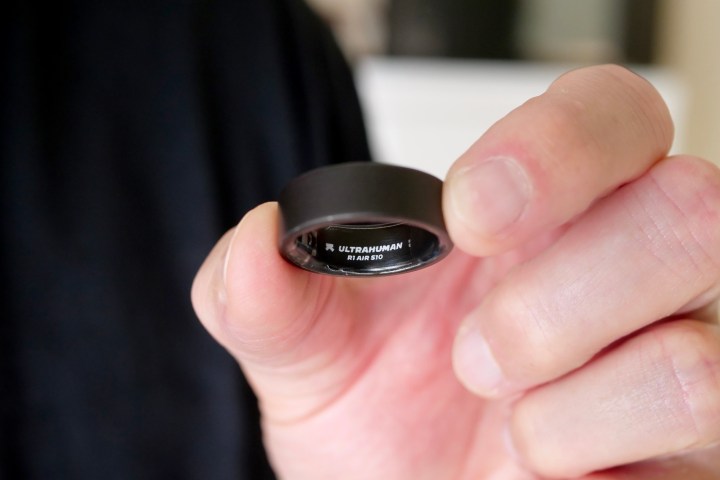
The Ultrahuman Ring Air embodies minimalism at its core, boasting a sleek, no-frills design. It lacks the tapered edges, ridges, or dimples you might find in other rings and is currently available only in a dark matte gray finish (though a polished version is expected soon). This simple, circular shape leans toward a masculine aesthetic, but its understated style might appeal to anyone looking for subtlety over flashiness. However, if you prefer a statement piece, this design might feel a bit too ordinary.
One clear advantage of wearing a smart ring over a smartwatch is the ability to keep your wrists free for traditional watches—something I personally appreciate. It’s also more discreet than a fitness band, blending into your everyday look. Despite housing advanced tech, the Ultrahuman Ring Air doesn’t scream “wearable device” thanks to its hidden sensors on the underside.
The ring is made from titanium with a resin underside, which has proven comfortable for all-day wear without irritating my skin. After extended use, it has picked up a few small scratches, though nothing that significantly detracts from its overall appearance. The matte finish, however, seems prone to marking, especially when dragged against hard surfaces like brick or metal. Its substantial build sometimes leads to an uncomfortable scraping sensation in such situations.
Fit, Comfort, and Comparisons
I’ve worn the Ultrahuman Ring Air on the same finger that housed my Oura Ring for over 18 months, so I’m used to the feel of a smart ring. That said, the Ultrahuman Ring Air felt slightly more noticeable, particularly in the first few days. Despite only a marginal difference in size—8.1mm wide versus the Oura’s 7.9mm—it was perceptible.
Sizing was also a bit tricky. I initially chose a size 11 using the provided sizing kit, but it ended up being too large (possibly due to trying the kit on particularly hot days). Ultrahuman promptly exchanged it for a size 10, which fits perfectly. Interestingly, my Oura Ring is a size 11, suggesting the two brands may follow slightly different sizing metrics. Both rings weigh 3 grams, so there’s no significant difference in heft.
Design: Functional but Uninspired
While the Ultrahuman Ring Air is comfortable and functional, its design feels somewhat uninspired. The flat sides give it a utilitarian, almost generic look, reminiscent of smartwatches designed with practicality in mind but lacking the flair that creates an emotional connection. This is important for something meant to be worn all the time. Unlike the Oura Ring, which offers varied designs and finishes that exude elegance, the Ultrahuman Ring Air feels more like a functional gadget than stylish jewelry.
Sensors, Durability, and Battery Life
Underneath the ring’s hypoallergenic resin underside lies the sensor array, which includes:
- Infrared Photoplethysmography (PPG) with red, green, and infrared LEDs for heart rate and blood oxygen monitoring.
- A skin temperature sensor and six-axis accelerometer for tracking movement.
Unlike the Oura Ring’s raised contact points, the Ultrahuman Ring Air uses a flat section to maintain skin contact. It also houses a 24mAh battery that charges via an included plinth. Battery life averages about four days, though tracking workouts may reduce this slightly. A full recharge takes up to two hours.
I found it most convenient to top up the battery while showering or getting ready, which minimizes the need for full charges. However, the Oura Ring’s longer battery life (around 5-7 days) compensates better for forgetful users like me. One small annoyance: the charging plinth’s LED stays illuminated constantly, which could be bothersome if kept near your bed.
Durability-wise, the titanium case with a tungsten carbide coating helps resist scratches, but the company recommends avoiding contact with metal objects, such as during weightlifting, to protect the finish. The ring is water-resistant to 100 meters, making it safe for swimming, showering, or handwashing.
Health and Sleep Tracking: More Involvement Required
The Ultrahuman Ring Air goes beyond passive tracking, encouraging active engagement. To maximize its benefits, you’ll need to input details about your mood, food intake, and daily activities. While this deeper involvement may appeal to data enthusiasts, it makes the Ring Air less of a “wear-and-forget” tracker compared to the Oura Ring.
The app’s interface adds to the learning curve, using somewhat obscure terminology that might confuse even experienced health tracker users. The main system, called the Phase Response Curve (PRC), aims to optimize your day by suggesting ideal times to exercise, drink coffee, sleep, or avoid light exposure. However, terms like “Circadian Dead Zone,” “Minima time,” and “Phase Delay” aren’t clearly explained, leaving users to decipher their meaning.
The Stimulant Focus
The app also places an unusual emphasis on caffeine intake, highlighting windows like the “Stimulant Permissible Window” during the day and suggesting how different caffeinated drinks will affect your system. While this is an interesting feature that raises awareness of caffeine’s impact, its presentation could be more intuitive and user-friendly.

The app’s focus is laser-sharp: monitoring my exposure to light and stimulants.
Beyond that, it delivers three core metrics—movement, sleep, and recovery—each backed by layers of detailed data. For movement, it tracks steps and workouts; for recovery, it keeps tabs on resting heart rate, skin temperature, and heart rate variability (HRV). These numbers give you a daily readiness score, helping you decide whether to push your limits or rest. You can also dive deeper into individual readings like HRV and skin temperature whenever you need more context.
Wearing the Ultrahuman Ring Air overnight is crucial since your sleep data feeds many of the app’s suggestions. It breaks down sleep into various stages and tracks heart rate, HRV, blood oxygen, skin temperature, and movement throughout the night. Each metric is rated and compared to your past performance, offering tips for improvement—like taking a pre-bedtime shower. However, while there’s plenty of data and visual graphs, the app doesn’t present it in the most user-friendly way, and I’ve struggled to connect with its recommendations or fully grasp my performance.
The design and language are partly to blame. While the scores provide helpful insights and generally align with how my body feels, the rest of the app feels overly complex, with minimal guidance on why the data matters.
The Ultrahuman Ring Air relies entirely on the mobile app, making it central to the user experience.
Unlike the ring, which lacks a display, the app must handle everything—and, on the plus side, it’s been reliably syncing with my iPhone 14 Pro (it’s also available on Android). Though manual syncing is occasionally needed, I haven’t encountered any connection issues.
Let’s talk design. The main screen displays all your essential metrics, and navigation options are at the bottom. The Metabolism tab, unfortunately, doubles as an ad for Ultrahuman’s M1 glucose monitor. The Discover tab provides mindfulness sessions, podcasts, and additional content, while the Profile tab holds your personal data.
This setup feels unnecessarily cluttered. The Metabolism ad and Profile section could have been tucked into a secondary menu to simplify the app’s layout. Currently, it’s a data-dense, somewhat overwhelming experience that could benefit from a more streamlined interface to improve engagement.
Compared to the Oura Ring, the Ultrahuman app is less intuitive. Oura makes key metrics instantly clear, dedicating separate screens to each one. The Ultrahuman Ring Air, in contrast, seems aimed at biohackers who crave granular data but struggles to make that complexity accessible. While its ambition to stand out is admirable, the execution occasionally stumbles, leaving it bogged down by its own design choices.
Ultrahuman Ring Air: fitness tracking and encouragement
The app’s Timeline view gathers your daily activity data and the personalized recommendations it provides based on your various phases. Hidden on the side is a discreet + symbol, which allows you to log your food and water intake, input your weight, and even record workouts. At the time of writing, a beta feature enables the ring to track 22 different activities, including running, walking, strength training, football, cricket, and more.
To test its accuracy, I tracked several workouts using both the Ultrahuman Ring Air and the Samsung Galaxy Watch 6 Classic. While both devices aligned closely on heart rate data, there were some minor differences in calorie burn estimates, though nothing wildly inconsistent. The ability to track a variety of workouts is a welcome feature — and a notable advantage over the Oura Ring, which primarily focuses on walking, cycling, and running. This expanded functionality makes the Ultrahuman Ring Air a viable replacement for a fitness band or smartwatch, especially if notifications and apps aren’t essential for you.
The app frequently sends notifications throughout the day, updating you on your current phase, stimulant window, and progress toward your goals. Unfortunately, the goals are pre-set by the app, and there’s no option to customize them, which is a frustrating limitation. For example, my daily target is set at 11,000 steps and 16 hours of activity, which is both unrealistic and unmotivating. Without the ability to tailor goals to your own pace, the app’s targets can feel more like unreachable milestones than helpful benchmarks.
Price, Availability, and Subscriptions
One of the Ultrahuman Ring Air’s biggest selling points is that it doesn’t require a subscription. Unlike the Oura Ring, which charges $6 per month to unlock all its features, the Ultrahuman Ring Air offers full functionality with a one-time purchase of $349. This makes it comparable in price to the Oura Ring and not too far off from other popular wearables like the Apple Watch Series 8 and Samsung Galaxy Watch 6 Classic. However, it is pricier than alternatives like the Apple Watch SE 2 or the Garmin Vivomove Trend — both of which are worth considering depending on your specific needs.
Be aware that availability may be limited. The official website warns of a four-to-six-week wait time after ordering, with an additional delay if you opt to use the sizing kit (which I highly recommend, as ring sizes can vary depending on factors like weather and finger swelling).
A More Active Development Approach
While the Ultrahuman app’s design isn’t as polished as Oura’s, it does benefit from more frequent software updates. In the month I’ve used the Ultrahuman Ring Air, it has received more updates than Oura has rolled out all year. This ongoing development adds value, especially in the absence of subscription fees.
Is the Ultrahuman Ring Air Actually Helpful?
The Ultrahuman Ring Air is undeniably comfortable, convenient, and loaded with features — but is it actually useful? It’s a somewhat unconventional device. It doesn’t quite fit into the category of a fashion-forward health tracker like the Garmin Vivomove Trend or the Apple Watch, but it also isn’t as lifestyle-oriented as the Oura Ring. Instead, it aims to offer a hybrid experience that leans more heavily toward fitness and performance tracking.
For me, its usefulness depends on how often I feel it has genuinely helped me understand my health, modify my behavior, or engage with the data it presents. I do frequently check my sleep scores, HRV readings, and skin temperature data, but I largely ignore the movement metric because I know I won’t hit its lofty targets.
The app’s focus on stimulants is interesting but not necessarily a feature I’d prioritize when choosing a health tracker. Additionally, while the app emphasizes adjusting your circadian rhythm, it doesn’t explain the benefits of doing so in much depth, leaving the advice feeling incomplete.
User Experience and Design
One area where the Ultrahuman app falls short is in user-friendliness. While it offers a wealth of data, it can also feel overly complex and cluttered with ads for the company’s other products. For example, the Discover section includes not just mindfulness content and podcasts but also promotions for Ultrahuman’s M1 glucose monitor.
Some of the mindfulness content is also a bit unconventional. The Bedtime Stories section features everything from ASMR-style romantic tales to stories narrated from a cat’s perspective. These quirky offerings may appeal to some, but I personally found them more distracting than relaxing.
Frequently Asked Questions
What makes this smart ring so confusing compared to other fitness trackers?
The confusion arises from its hybrid nature. It tries to combine elements of fitness tracking, sleep monitoring, and lifestyle metrics but lacks the clarity and simplicity of other wearables like the Apple Watch or Garmin. The app’s complexity, unclear goals, and excessive data make it difficult for users to fully understand how to optimize their health.
How does the smart ring compare to the Oura Ring and Apple Watch?
While the smart ring leans more toward fitness tracking than lifestyle monitoring like the Oura Ring, it lacks the ease of customization and streamlined experience of the Apple Watch. The Oura excels at sleep and recovery tracking, while the Apple Watch allows users to personalize goals and easily access data, which this ring struggles to match.
Does the smart ring require a subscription like other health wearables?
No, one of its advantages is that it doesn’t require a monthly subscription, unlike the Oura Ring, which charges $6 per month. However, despite saving on subscription fees, users may find the overall experience less polished and user-friendly.
What are the main limitations of the smart ring?
The inability to customize goals, unclear guidance on circadian clock adjustments, and the overwhelming amount of data presented without actionable insights are key drawbacks. Additionally, the app has ads promoting the company’s other products, which can detract from the user experience.
Who would benefit most from using this smart ring?
Fitness enthusiasts looking for a deeper dive into exercise metrics, heart rate variability (HRV), and sleep tracking may find it useful, particularly since it connects with apps like Apple Health and Google Fit. However, casual users or those seeking a simple, intuitive health tracker might find it overly complex and less rewarding.
Final Verdict
The Ultrahuman Ring Air has potential, but its complexity, lack of customization, and scattered focus hold it back from becoming a true leader in the health and fitness tracking space. Unlike the Apple Watch, which simplifies health tracking while offering a customizable user experience, the Ultrahuman app feels dense and at times confusing.
Compared to the Oura Ring, the Ultrahuman Ring Air feels more innovative and fitness-oriented, but it lacks the same level of polish and ease of use. However, it does integrate with several popular platforms, including Apple Health, Google Fit, Garmin, Fitbit, MyFitnessPal, Polar, and Suunto apps — though oddly, Strava isn’t supported.
